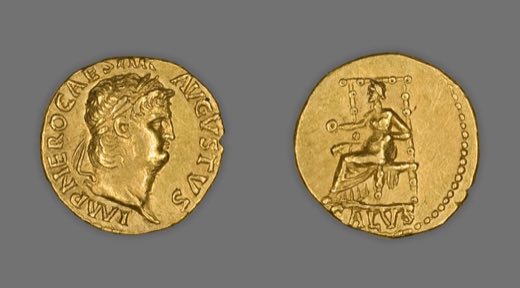
Augustus, the first Roman emperor (27 BC – AD 14), reorganized the provinces and their taxes; Luke sets Jesus’ birth in his reign. His stepson Tiberius (AD 14–37) ruled during Jesus’ ministry; Luke 3:1 dates John the Baptist to Tiberius’s fifteenth year.
Encyclopedia › Meanwhile in the world
In the Bible · c. 6–4 BC · Bethlehem
Jesus is born
During a Roman census Jesus is born in Bethlehem, the town of David, and shepherds come to see him. Herod the Great died in 4 BC.
Luke 2:1–20
Now in those days a decree went out from Caesar Augustus that a census should be taken of the whole empire. This was the first census to take place while Quirinius was governor of Syria. And everyone went to his own town to register. So Joseph also went up from Nazareth in Galilee to Judea, to the city of David called Bethlehem, since he was from the house and line of David. He went there to register with Mary, who was pledged to him in marriage and was expecting a child. While they were there, the time came for her Child to be born. And she gave birth to her firstborn, a Son. She wrapped Him in swaddling cloths and laid Him in a manger, because there was no room for them in the inn. And there were shepherds residing in the fields nearby, keeping watch over their flocks by night. Just then an angel of the Lord stood before them, and the glory of the Lord shone around them, and they were terrified. But the angel said to them, “Do not be afraid! For behold, I bring you good news of great joy that will be for all the people: Today in the city of David a Savior has been born to you. He is Christ the Lord! And this will be a sign to you: You will find a baby wrapped in swaddling cloths and lying in a manger.” And suddenly there appeared with the angel a great multitude of the heavenly host, praising God and saying: “Glory to God in the highest, and on earth peace to men on whom His favor rests!” When the angels had left them and gone into heaven, the shepherds said to one another, “Let us go to Bethlehem and see this thing that has happened, which the Lord has made known to us.” So they hurried off and found Mary and Joseph and the Baby, who was lying in the manger. After they had seen the Child, they spread the message they had received about Him. And all who heard it were amazed at what the shepherds said to them. But Mary treasured up all these things and pondered them in her heart. The shepherds returned, glorifying and praising God for all they had heard and seen, which was just as the angel had told them.At the same time in the world
Jesus was born in the reign of the emperor Augustus (Luke 2:1), probably between 6 and 4 BC — before the death of Herod the Great, usually dated 4 BC — and taught in the reign of Tiberius (Luke 3:1). Here is the world of his lifetime.
Greece and RomeAugustus and Tiberius27 BC – AD 37
ChinaThe Han and the Silk Road206 BC – AD 220
China under the Han dynasty had about as many people as the Roman Empire — a census of AD 2 counted some 57 million. Caravans carried Chinese silk west along the Silk Road; Romans wore it while knowing little of the land it came from.
IndiaRome trades with India1st century AD
Greek and Roman ships crossed the Arabian Sea with the monsoon winds to ports such as Muziris in southern India, to buy pepper and spices. Hoards of Roman coins of Augustus and Tiberius have been found in southern India.
The AmericasTeotihuacanfrom c. 100 BC
In the Valley of Mexico, Teotihuacan was growing into one of the largest cities of the ancient Americas. Its great Pyramid of the Sun was built over the next two centuries.
Eastern Europe and the steppeSarmatians on the steppe1st century AD
The Sarmatians, horse-riding nomads related to the Scythians, now held the steppes from the Don to the Danube. The last Scythians kept a small kingdom in Crimea.
Eastern Europe and the steppeGreek cities of Crimea1st century AD
On the coast of Crimea stood old Greek cities: Chersonesus, near today’s Sevastopol, and Panticapaeum, capital of the Bosporan Kingdom, whose kings ruled as allies of Rome.
Eastern Europe and the steppeThe Slavs are not yet namedfirst named in the 6th century AD
No written source of Jesus’ time names the Slavs. They first appear clearly in the 6th century AD, in the Gothic history of Jordanes and in Procopius. Where their ancestors lived in the 1st century is debated among historians and archaeologists.
EgyptEgypt, a Roman provincefrom 30 BC
After Cleopatra’s death in 30 BC, Egypt became a Roman province, and its grain fed the city of Rome. Matthew tells of Jesus’ family fleeing there; Alexandria had one of the largest Jewish communities of the time.