Encyclopedia › Buildings and structures
Buildings and structures
Dressed stone
Hebrew ’even gazith, mgerah · Greek lithos xustos · blocks cut square for palaces and temples
Ordinary houses were built of fieldstones, rough and uncut, set in mud. Palaces, temples and city gates were built of dressed stone: blocks quarried from the bedrock and squared so that they lay tight against each other. Phoenician masons worked for David and Solomon, and fine walls of such blocks survive at Samaria, Megiddo and other royal cities. For Solomon’s temple the stone was cut at the quarry, “so that no hammer or chisel or any other iron tool was heard in the temple while it was being built” (1 Kings 6:7). Finished stone was a builder’s pride: when their houses fell, the people of Ephraim boasted, “The bricks have fallen, but we will rebuild with finished stone” (Isaiah 9:10).
Solomon’s palace buildings were of costly stones “trimmed with saws inside and out” (1 Kings 7:9). The tool behind the word megerah is uncertain: archaeologists find no saw marks on stones of the period, and one proposal is a heavy metal tool with a rough face, pushed back and forth like a file. Herod’s builders cut blocks many meters long for the temple platform in Jerusalem, and a disciple said, “Teacher, look at the magnificent stones!” Jesus answered, “Not one stone here will be left on another” (Mark 13:1–2), and in AD 70 the Romans destroyed the temple. The Law, though, forbade an altar of stones “shaped by tools” (Exodus 20:25).
In art
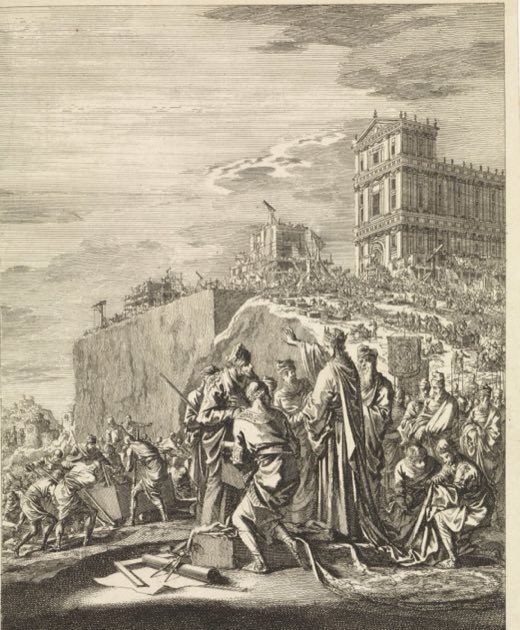 Solomon Builds the Temple
All verses that name it (13)
Where the Hebrew, Aramaic or Greek word for it stands in the text.
Exodus1
Now if you make an altar of stones for Me, you must not build it with stones shaped by tools; for if you use a chisel on it, you will defile it.2 Samuel1
David brought out the people who were there and put them to work with saws, iron picks, and axes, and he made them work at the brick kilns. He did the same to all the Ammonite cities. Then David and all his troops returned to Jerusalem.1 Kings5
And the king commanded them to quarry large, costly stones to lay the foundation of the temple with dressed stones.Solomon built the inner courtyard with three rows of dressed stone and one row of trimmed cedar beams.All these buildings were constructed with costly stones, cut to size and trimmed with saws inside and out from the foundation to the eaves, and from the outside to the great courtyard.Above these were high-grade stones, cut to size, and cedar beams.The great courtyard was surrounded by three rows of dressed stone and a row of trimmed cedar beams, as were the inner courtyard and portico of the house of the LORD.1 Chronicles2
David brought out the people who were there and put them to work with saws, iron picks, and axes. And he did the same to all the Ammonite cities. Then David and all his troops returned to Jerusalem.So David gave orders to gather the foreigners in the land of Israel, from whom he appointed stonecutters to prepare finished stones for building the house of God.Isaiah1
“The bricks have fallen, but we will rebuild with finished stone; the sycamores have been felled, but we will replace them with cedars.”Lamentations1
He has barred my ways with cut stones; He has made my paths crooked.Ezekiel1
There were also four tables of dressed stone for the burnt offering, each a cubit and a half long, a cubit and a half wide, and a cubit high. On these were placed the utensils used to slaughter the burnt offerings and the other sacrifices.Amos1
Therefore, because you trample on the poor and exact from him a tax of grain, you will never live in the stone houses you have built; you will never drink the wine from the lush vineyards you have planted.See also
- Foundations and cornerstonesBuildings and structures
- Bricks, mortar and plasterBuildings and structures
- Plumb line and measuring lineBuildings and structures
- Columns and pillarsBuildings and structures
- Solomon’s templeTabernacle and temple
- Limestone, chalk and flintWeather and the forces of nature
- Mines and quarriesWeather and the forces of nature
- Stone vesselsTrade, craft and color
- Forced labor and the king’s levyWork and trades
Sources: Tyndale Open Bible Dictionary © 2023 Tyndale House Publishers, CC BY-SA 4.0 — adapted and shortened; the original work is available for free at tyndaleopenresources.com · Human-made Things in the Bible © United Bible Societies 2025, adapted from R. Pritz, The Works of Their Hands: Man-made Things in the Bible © 2009 UBS, CC BY-SA 4.0 · Sources and rights