Encyclopedia › Ancient texts beside the Bible
Ancient texts beside the Bible
Thallus, Phlegon and the darkness
Known only through Julius Africanus · an eclipse of the sun? · Phlegon’s eclipse of AD 32/33
The Gospels tell that while Jesus hung on the cross, “darkness came over all the land until the ninth hour. The sun was darkened” (Luke 23:44–45). Early in the 3rd century the Christian chronographer Julius Africanus wrote that a historian called Thallus, in the third book of his histories, explained this darkness away as an eclipse of the sun — wrongly, Africanus says, since an eclipse cannot happen at the full moon of Passover. Africanus’ work is lost too; this passage survives only as a quotation in a Byzantine chronicle of the 9th century.
Who Thallus was and when he wrote is uncertain. If Africanus read him rightly, a writer who was not a Christian, perhaps in the 1st century, already knew the story of the darkness and tried to account for it. Some scholars accept this; others think Thallus only recorded an eclipse, and that Africanus connected it with the crucifixion. Africanus also cites Phlegon of Tralles, a freedman of the emperor Hadrian, whose Olympiads tell of a great eclipse in the fourth year of the 202nd Olympiad, AD 32 or 33, when it became night at the sixth hour of the day, stars were seen, and an earthquake struck Bithynia. Astronomers note that a total eclipse visible in that region happened in AD 29, and that Phlegon may mean that one.
In art
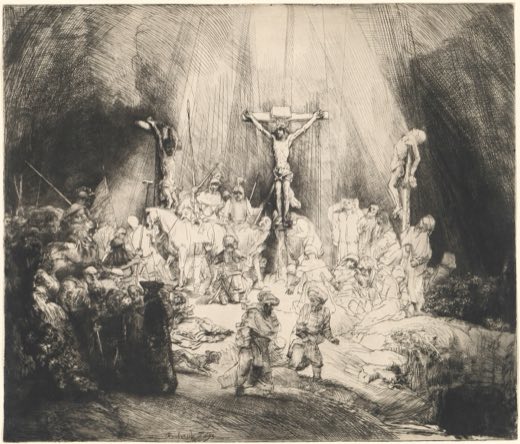 Christ Crucified between the Two Thieves (The Three Crosses)
See also
- Darkness at middayThe sky of the Bible
- Eclipses and the darkened skyThe sky of the Bible
- Tacitus on Nero and the ChristiansAncient texts beside the Bible
- Mara bar Serapion and the “wise king”Ancient texts beside the Bible
Sources: Tyndale Open Bible Dictionary © 2023 Tyndale House Publishers, CC BY-SA 4.0 — adapted and shortened; the original work is available for free at tyndaleopenresources.com · Sources and rights