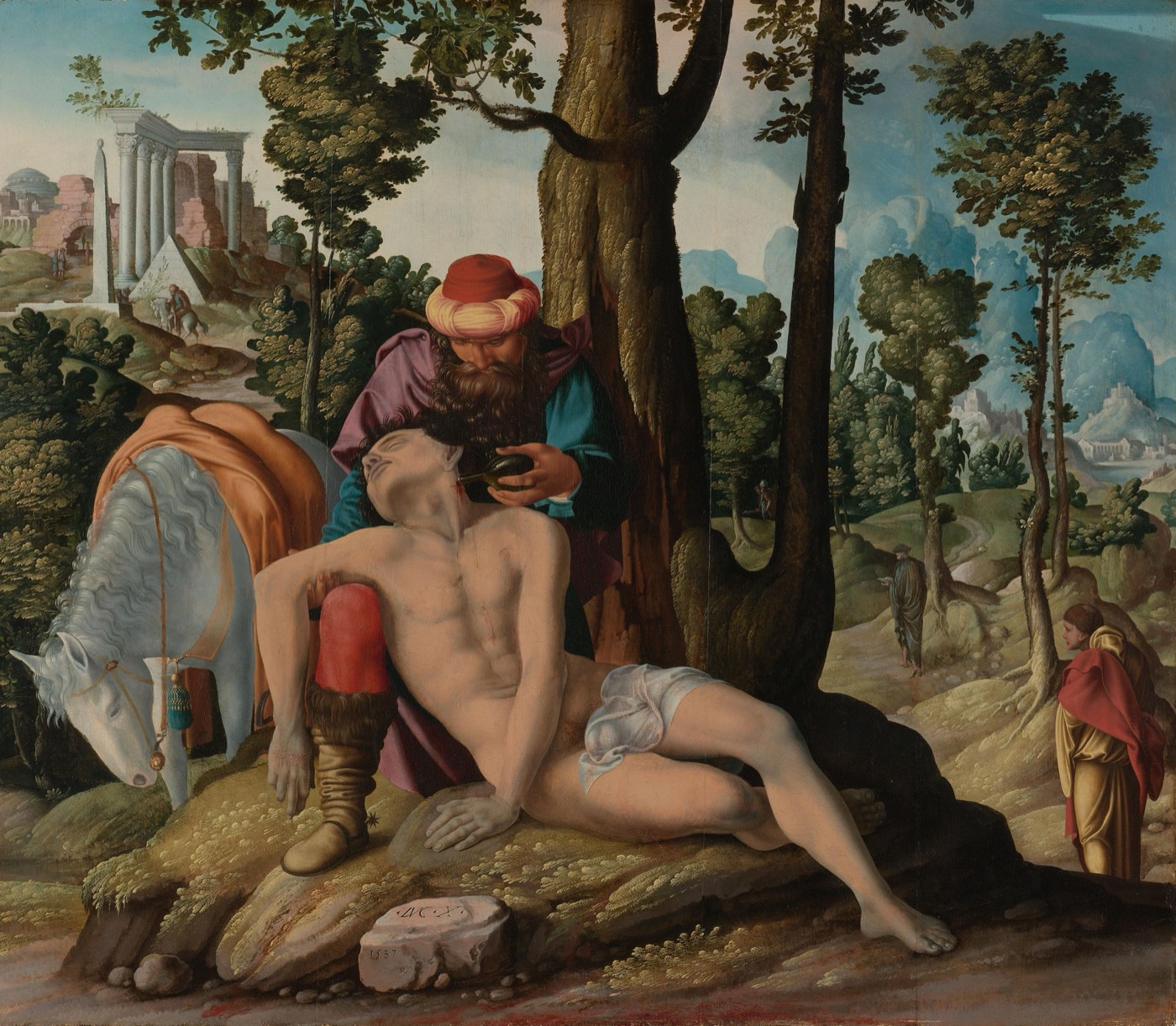
The Samaritan pours from a dark flask at the wounded man’s neck.
Bible in art · Luke
The Good Samaritan
Master of the Good Samaritan · 1537
Rijksmuseum, Amsterdam
The painter of this panel is unknown: he is named after this very picture, the Master of the Good Samaritan, and probably worked in Utrecht. A stone at the bottom carries the date 1537 and “LUC X”, for Luke chapter 10.
In a wooded landscape a bearded traveller in a turban holds up the wounded man and pours from a flask. His white horse waits beside them, and far behind, two men walk away along the road.
From the text
- “They stripped him, beat him, and went away, leaving him half dead” (Luke 10:30)
- A priest and a Levite who “passed by on the other side” (Luke 10:31–32)
- “He went to him and bandaged his wounds, pouring on oil and wine” (Luke 10:34)
- “Then he put him on his own animal” (Luke 10:34)
The artist’s own
- A turban, the way painters of the time marked a man from the East
- Roman ruins — columns, an obelisk, a pyramid — as Netherlandish painters liked to show after visits to Italy
- A white horse for “his own animal”
- One of the passers-by dressed, the museum notes, like a monk of the painter’s day
Details
Oil and wine
Half dead
Stripped but for a white cloth, the man lies back with his eyes closed.
The horse
A white horse with an orange saddle-cloth waits, head lowered.
Ruins
Columns, an obelisk, a pyramid and a dome on the hill; a rider on the road below.
Passing by
Two men walk away along the road, the nearer in a red cloak.
“LUC X · 1537”
The stone gives the chapter of Luke and the year.
Master of the Good Samaritan, Netherlandish, active c. 1537–1545/46 (Utrecht?). Rijksmuseum, Amsterdam (J.H. Besier Bequest; SK-A-3468) · Oil on panel · Image: "Public Domain" (https://creativecommons.org/publicdomain/mark/1.0/); object metadata: CC0 1.0 (https://creativecommons.org/publicdomain/zero/1.0/) — Rijksmuseum Linked Art record.