Encyclopedia › Trade, craft and color
Trade, craft and color
Paul’s letters among the letters of their time
The frame of a Greek letter · a secretary · Philemon about 335 words, Romans about 7,100
Thousands of private letters of the Roman world survive on papyrus from Egypt. Most are short — by one count about 90 words on average — and follow the pattern of their time: the sender, the receiver, a greeting, a wish for good health, the business, greetings to others and a farewell. Paul’s letters keep the same frame and fill it with the faith: instead of the plain Greek “greetings”, chairein, he writes “grace and peace”, and then gives thanks to God: “I thank my God every time I remember you” (Philippians 1:3). But they are far longer than ordinary letters: Philemon has about 335 Greek words, and Romans about 7,100 — longer than the longest letters of Cicero or Seneca.
Paul, like many writers of his day, dictated to a secretary, and one of them adds his own greeting: “I, Tertius, who wrote down this letter, greet you in the Lord” (Romans 16:22). At the end Paul often took the pen himself: “This greeting is in my own hand — Paul” (1 Corinthians 16:21). He names co-senders — Silvanus, Timothy, Sosthenes — and writes to a household church as well as to a person: to Philemon, to Apphia, to Archippus “and to the church that meets at your house” (Philemon 1:2). His letters were read aloud to the gathered believers: “I charge you before the Lord to have this letter read to all the brothers” (1 Thessalonians 5:27), and several close with long lists of greetings and “Greet one another with a holy kiss” (Romans 16:16).
In art
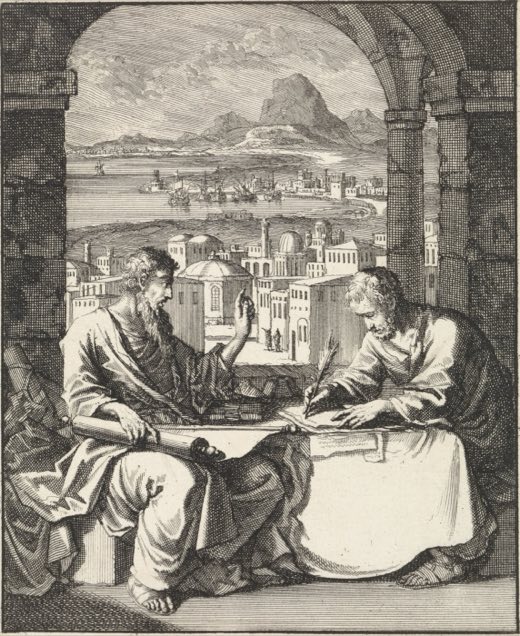 Paul Dictates the Letter to the Romans
All verses on this topic
See also
- LettersWriting and books
- Who carried the apostles’ lettersTrade, craft and color
- ScribeWork and trades
- Reading aloudWriting and books
- How Paul’s letters were gatheredHow the Bible came to be
- PaulPeople
- TertiusPeople
Sources: Tyndale Open Bible Dictionary © 2023 Tyndale House Publishers, CC BY-SA 4.0 — adapted and shortened; the original work is available for free at tyndaleopenresources.com · Sources and rights