Encyclopedia › The land of the Bible
The land of the Bible
The mount of the Beatitudes
“He went up on the mountain” · a hill above Tabgha · a church of 1938
Matthew sets Jesus’ best-known teaching on a hill: “When Jesus saw the crowds, He went up on the mountain and sat down” (Matthew 5:1), and it ends with “a city on a hill cannot be hidden” (Matthew 5:14). Luke gives much of the same teaching after Jesus “came down with them and stood on a level place” (Luke 6:17). Neither Gospel names the place. Since the story belongs to Jesus’ work around Capernaum, Christians looked for it on the slopes above the north shore of the Sea of Galilee.
By the 4th century pilgrims were shown a spot near Tabgha, a little west of Capernaum, where springs run into the lake; the pilgrim Egeria describes a cave there on the hill where the Lord spoke the Beatitudes, and the ruins of a small Byzantine chapel have been found on the lower slope. The present Church of the Beatitudes, higher up the hill, was built in 1938 to a design by the Italian architect Antonio Barluzzi; it has eight sides, one for each Beatitude, and looks out over the lake. The hillside forms a natural amphitheatre, and visitors have tested how well a speaker can be heard from the shore. In the Middle Ages another tradition placed the sermon on the Horns of Hattin, a double hill west of Tiberias.
In art
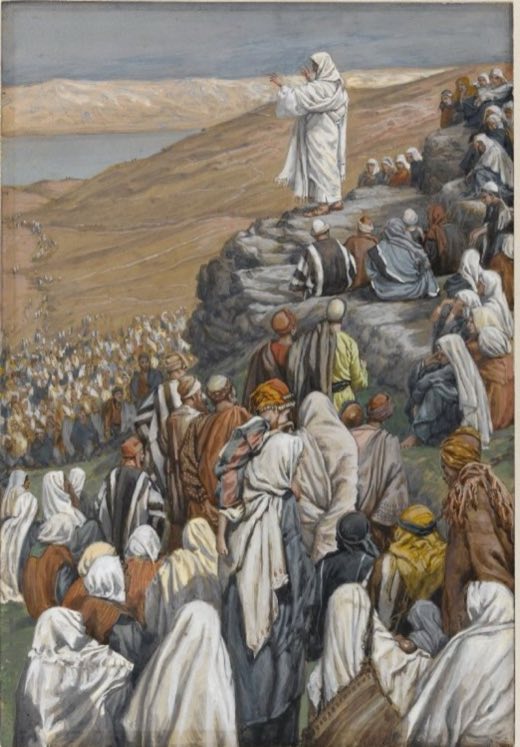 The Sermon of the Beatitudes (Le sermon des béatitudes)James Tissot
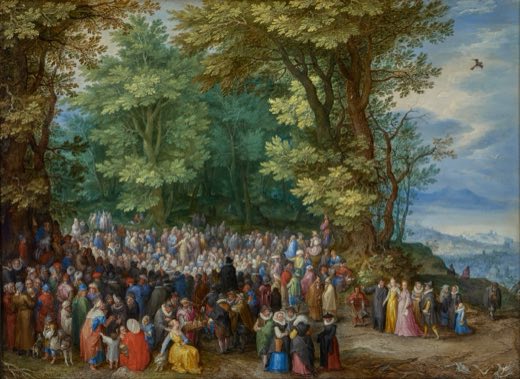 The Sermon on the MountJan Brueghel the Elder
See also
- The BeatitudesVirtues
- Galilee: hills, valleys and the lakeThe land of the Bible
- Capernaum: a fishing town on the lakeCities of the Bible
- Mount Tabor: the dome above the plainThe land of the Bible
- The Sea of GalileeThe sea
- CapernaumPlaces
Sources: Tyndale Open Bible Dictionary © 2023 Tyndale House Publishers, CC BY-SA 4.0 — adapted and shortened; the original work is available for free at tyndaleopenresources.com · Sources and rights