Encyclopedia › Feasts and festivals
Feasts and festivals
Booths and shelters
Hebrew sok, sukah · Greek skēnē · a hut of branches · in fields, vineyards and camps
A booth, sukkah in Hebrew, was a rough shelter of poles and leafy branches, reeds or grass, put up for a season and left to fall apart. Farmers and watchmen built them in vineyards and melon fields to guard the ripening crop; a deserted one stood for loneliness: Jerusalem is “abandoned like a shelter in a vineyard, like a shack in a cucumber field” (Isaiah 1:8). Job speaks of “a hut set up by a watchman” (Job 27:18). Jacob built shelters for his livestock, and the place was named Succoth, “booths” (Genesis 33:17); and armies camped in them: Uriah’s “dwelling in tents” (2 Samuel 11:11) is in Hebrew “in booths”.
Jonah sat in the shade of his own shelter east of Nineveh (Jonah 4:5). The best known booths belong to the autumn feast named after them, when families lived for seven days in shelters of branches (Leviticus 23:42). The Mishnah later required a roof of cut branches giving more shade than sun; by custom the stars show through. On the mountain of the Transfiguration Peter offered to put up “three shelters” (Matthew 17:4), skēnai in Greek, the word the Greek Bible uses for the booths of the feast.
In art
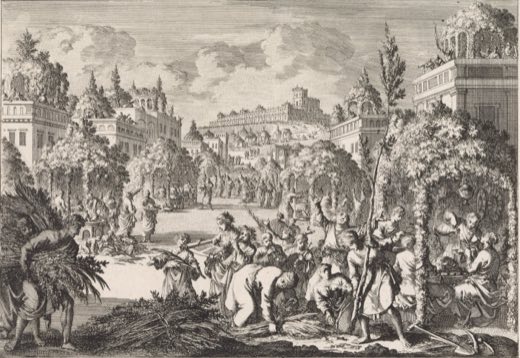 Making Booths for the Feast
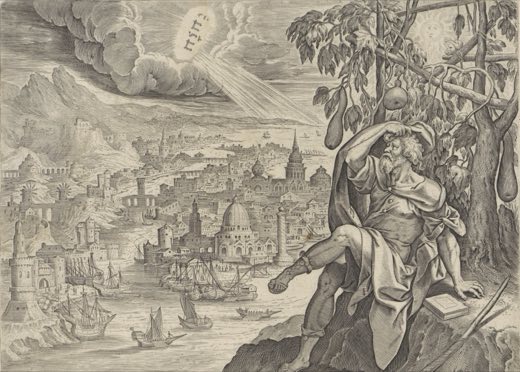 Jonah under the Gourd
All verses that name it (38)
Where the Hebrew, Aramaic or Greek word for it stands in the text.
Genesis1
but Jacob went on to Succoth, where he built a house for himself and shelters for his livestock; that is why the place was called Succoth.Leviticus3
“Speak to the Israelites and say, ‘On the fifteenth day of the seventh month the Feast of Tabernacles to the LORD begins, and it continues for seven days.You are to dwell in booths for seven days. All the native-born of Israel must dwell in booths,so that your descendants may know that I made the Israelites dwell in booths when I brought them out of the land of Egypt. I am the LORD your God.’”Deuteronomy3
You are to celebrate the Feast of Tabernacles for seven days after you have gathered the produce of your threshing floor and your winepress.Three times a year all your men are to appear before the LORD your God in the place He will choose: at the Feast of Unleavened Bread, the Feast of Weeks, and the Feast of Tabernacles. No one should appear before the LORD empty-handed.Then Moses commanded them, “At the end of every seven years, at the appointed time in the year of remission of debt, during the Feast of Tabernacles,2 Samuel2
Uriah answered, “The ark and Israel and Judah are dwelling in tents, and my master Joab and his soldiers are camped in the open field. How can I go to my house to eat and drink and sleep with my wife? As surely as you live, and as your soul lives, I will not do such a thing!”He made darkness a canopy around Him, a gathering of water and thick clouds.1 Kings2
Ben-hadad received this message while he and the kings were drinking in their tents, and he said to his servants, “Take your positions.” So they stationed themselves against the city.They marched out at noon while Ben-hadad and the 32 kings allied with him were in their tents getting drunk.2 Chronicles1
He observed the daily requirement for offerings according to the commandment of Moses for Sabbaths, New Moons, and the three annual appointed feasts—the Feast of Unleavened Bread, the Feast of Weeks, and the Feast of Tabernacles.Ezra1
They also celebrated the Feast of Tabernacles in accordance with what is written, and they offered burnt offerings daily based on the number prescribed for each day.Nehemiah4
And they found written in the Law, which the LORD had commanded through Moses, that the Israelites were to dwell in booths during the feast of the seventh month.So they proclaimed this message and spread it throughout their towns and in Jerusalem, saying, “Go out to the hill country and bring back branches of olive, wild olive, myrtle, palm, and other leafy trees, to make booths, as it is written.”And the people went out, brought back branches, and made booths on their own rooftops, in their courtyards, in the court of the house of God, and in the squares by the Water Gate and by the Gate of Ephraim.The whole assembly who had returned from exile made booths and lived in them. From the days of Joshua son of Nun until that day, the Israelites had not celebrated like this. And there was great rejoicing.Job3
The house he built is like a moth’s cocoon, like a hut set up by a watchman.Furthermore, who can understand how the clouds spread out, how the thunder roars from His pavilion?when they crouch in their dens and lie in wait in the thicket?Psalms5
He lies in wait like a lion in a thicket; he lurks to seize the oppressed; he catches the lowly in his net.He made darkness His hiding place, and storm clouds a canopy around Him.For in the day of trouble He will hide me in His shelter; He will conceal me under the cover of His tent; He will set me high upon a rock.You hide them in the secret place of Your presence from the schemes of men. You conceal them in Your shelter from accusing tongues.His tent is in Salem, His dwelling place in Zion.Isaiah2
And the Daughter of Zion is abandoned like a shelter in a vineyard, like a shack in a cucumber field, like a city besieged.a shelter to give shade from the heat by day, and a refuge and hiding place from the storm and the rain.Jeremiah1
He has left His den like a lion, for their land has been made a desolation by the sword of the oppressor, and because of the fierce anger of the LORD.Amos1
“In that day I will restore the fallen tent of David. I will repair its gaps, restore its ruins, and rebuild it as in the days of old,Jonah1
Then Jonah left the city and sat down east of it, where he made himself a shelter and sat in its shade to see what would happen to the city.Zechariah3
Then all the survivors from the nations that came against Jerusalem will go up year after year to worship the King, the LORD of Hosts, and to celebrate the Feast of Tabernacles.And if the people of Egypt will not go up and enter in, then the rain will not fall on them; this will be the plague with which the LORD strikes the nations who do not go up to celebrate the Feast of Tabernacles.This will be the punishment of Egypt and of all the nations that do not go up to celebrate the Feast of Tabernacles.Matthew1
Peter said to Jesus, “Lord, it is good for us to be here. If You wish, I will put up three shelters—one for You, one for Moses, and one for Elijah.”Mark1
Peter said to Jesus, “Rabbi, it is good for us to be here. Let us put up three shelters—one for You, one for Moses, and one for Elijah.”Luke1
As Moses and Elijah were leaving, Peter said to Jesus, “Master, it is good for us to be here. Let us put up three shelters—one for You, one for Moses, and one for Elijah.” (He did not know what he was saying.)John1
However, the Jewish Feast of Tabernacles was near.Acts1
‘After this I will return and rebuild the fallen tent of David. Its ruins I will rebuild, and I will restore it,All verses on this topic
See also
Sources: Tyndale Open Bible Dictionary © 2023 Tyndale House Publishers, CC BY-SA 4.0 — adapted and shortened; the original work is available for free at tyndaleopenresources.com · Human-made Things in the Bible © United Bible Societies 2025, adapted from R. Pritz, The Works of Their Hands: Man-made Things in the Bible © 2009 UBS, CC BY-SA 4.0 · Sources and rights