The desert
John the Baptist in the wilderness
A voice in the wilderness · camel’s hair · locusts and wild honey · baptism in the Jordan
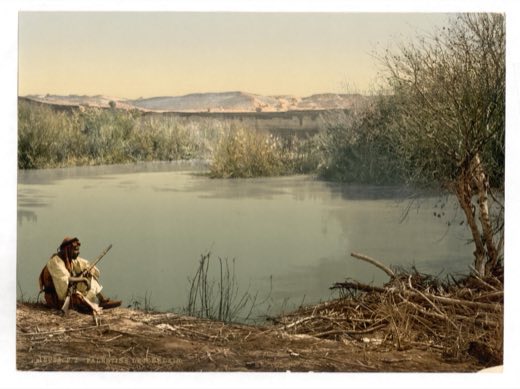
Luke says that John, son of the priest Zechariah, “lived in the wilderness until the time of his public appearance to Israel” (Luke 1:80). Then, in the fifteenth year of the emperor Tiberius, about AD 28–29, “the word of God came to John son of Zechariah in the wilderness” (Luke 3:2). He preached in the wilderness of Judea and baptized in the Jordan, at places such as “Bethany beyond the Jordan” (John 1:28), near where the river flows into the Dead Sea.
His dress and food were those of the desert. He wore “a garment of camel’s hair, with a leather belt around his waist” — like Elijah, “a hairy man” with a leather belt (2 Kings 1:8) — and “His food was locusts and wild honey” (Matthew 3:4). Locusts were among the insects the Law allowed, and desert people of the region ate them until recent times. Asked who he was, John answered in the words of Isaiah: “I am a voice of one calling in the wilderness, ‘Make straight the way for the Lord.’” (John 1:23).
People went out to him “from all of Jerusalem and the countryside of Judea” (Mark 1:5), and Jesus later asked the crowds, “What did you go out into the wilderness to see? A reed swaying in the wind?” (Matthew 11:7). John pointed to the One coming after him and baptized Jesus in the Jordan. Some scholars have compared him with the community at Qumran nearby; the Gospels do not link them.
See also
- The Judean wildernessThe desert
- The temptation of Jesus in the wildernessThe desert
- Locusts, wild honey and food from the wildFood and drink
- The Jordan: a river in the riftThe land of the Bible
- Essenes and QumranJewish groups and the Roman world
- Herod’s fortress-palaces: Herodium and MachaerusBuildings and structures
- The disciples of John the BaptistJewish groups and the Roman world
- John, son of ZechariahPeople
Scholars disagree
Sources: Tyndale Open Bible Dictionary © 2023 Tyndale House Publishers, CC BY-SA 4.0 — adapted and shortened; the original work is available for free at tyndaleopenresources.com · Sources and rights