Encyclopedia › The Bible in culture
The Bible in culture
Mendelssohn’s Elijah
Oratorio · first sung in Birmingham, 26 August 1846 · the contest on Mount Carmel
Felix Mendelssohn’s oratorio Elijah tells the prophet’s story from 1 and 2 Kings in a series of scenes for soloists, choir and orchestra. The German text was put together from the Bible by the pastor Julius Schubring; for its first performance, at the Birmingham Music Festival on 26 August 1846 with Mendelssohn conducting, it was translated into English by William Bartholomew, and it has been sung in both languages ever since. Mendelssohn died the next year, aged thirty-eight.
The work opens with Elijah’s announcement of drought — “there will be neither dew nor rain in these years except at my word” (1 Kings 17:1) — before the overture. Then come the widow’s son brought back to life, and the contest on Mount Carmel, where the prophets of Baal cry out again and again with no answer, until fire falls and the people shout, “The LORD, He is God!” (1 Kings 18:39). After the rain the story follows Elijah to the wilderness and to Horeb, where God passes by not in the wind, the earthquake or the fire, but in “a still, small voice” (1 Kings 19:12), and ends with the chariot of fire (2 Kings 2:11). Between the scenes come psalms; two of the best known are the chorus “He, watching over Israel” from Psalm 121 and the aria “O rest in the Lord” from Psalm 37.
In art
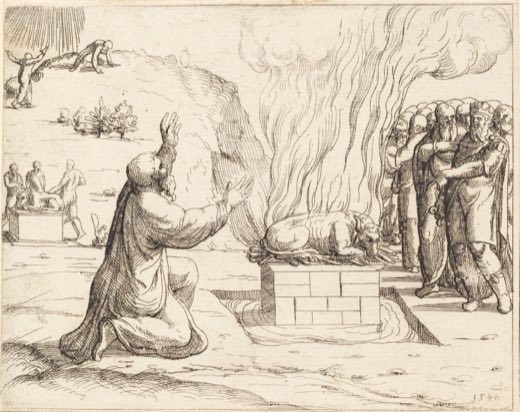 The Rival Sacrifices of Elijah and the Priests of BaalAugustin Hirschvogel
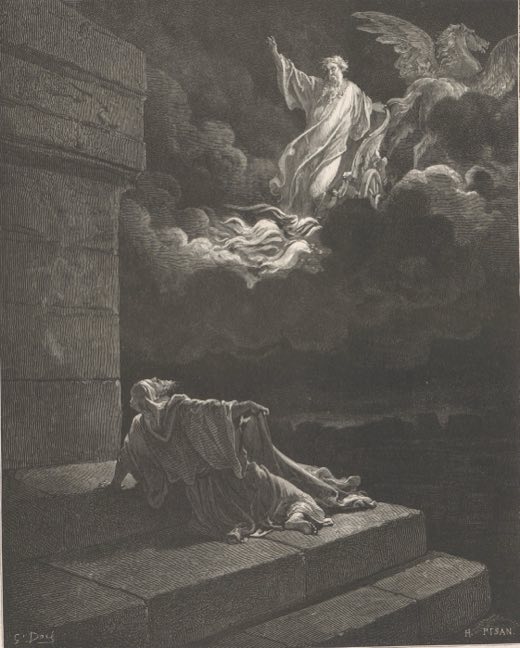 Elijah Taken Up in a Chariot of FireGustave Doré