Encyclopedia › The Bible in culture
The Bible in culture
Operas on Bible stories
Verdi’s Nabucco (1842) · Saint-Saëns’ Samson and Delilah (1877) · Strauss’s Salome (1905)
Opera came to Bible stories later than oratorio, and some cities long forbade biblical figures on the opera stage. Giuseppe Verdi’s Nabucco, first performed at La Scala in Milan on 9 March 1842, is set in Jerusalem and Babylon under Nebuchadnezzar, whom pride drives mad until he turns to the God of Israel — a free reworking of Daniel 4. Its chorus of the Hebrew captives, “Va, pensiero”, is a paraphrase of Psalm 137, “By the rivers of Babylon we sat and wept” (Psalm 137:1); it later became a beloved song of Italian national feeling and was sung when Verdi was buried in 1901.
Camille Saint-Saëns’ Samson and Delilah, from Judges 16, could not at first be staged in Paris and had its premiere in Weimar in 1877, in German, with help from Franz Liszt; Delilah’s aria “My heart opens to your voice” is one of the best-known in opera. Richard Strauss’s Salome (Dresden, 1905), after Oscar Wilde’s play, takes the story of the dancing girl who asked for John the Baptist’s head (Mark 6:22–28); the Gospels do not give her name, which comes from Josephus. Its “Dance of the Seven Veils” and its ending caused scandal, and it was banned for a time in London and New York. Arnold Schoenberg’s unfinished Moses and Aaron sets the two brothers against each other at the golden calf; it was first staged in Zurich in 1957.
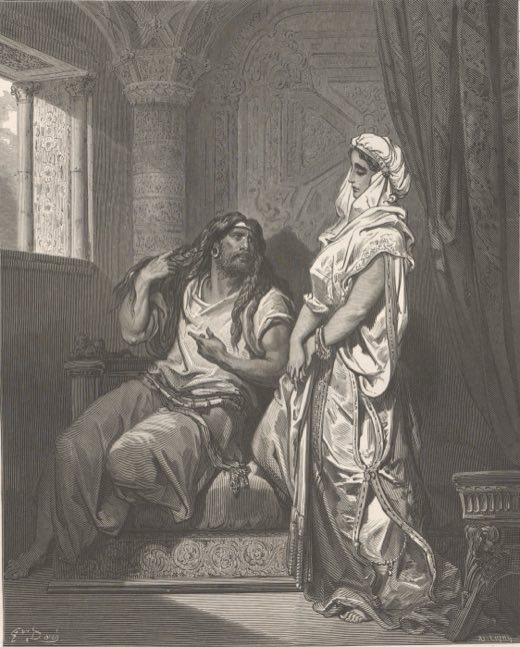 Samson and Delilah