Encyclopedia › Animals of the Bible
Animals of the Bible
Wild donkey
Named in 11 verses of the Bible, in 7 books.
Hebrew pere’, arod · the onager and the African wild ass
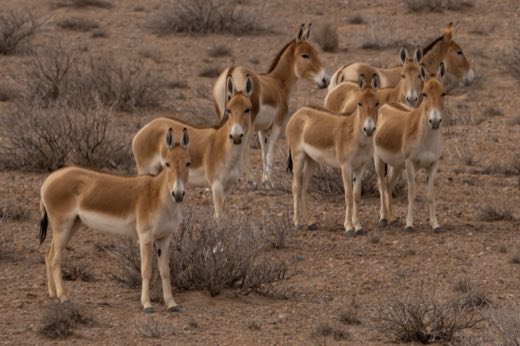
Two wild asses were known in Bible times. The onager, or Asiatic wild ass, roamed the deserts and steppes of Syria, Mesopotamia and the Negev; it is larger than a donkey, fawn with a pale belly, and very fast. The African wild ass of the Nile lands and the Red Sea coast is the ancestor of the tame donkey. Both were hunted for meat, and the Hebrew words pere’ and arod may mean the two of them — Job 39:5 uses both side by side.
No one ever really tamed the onager, and the Bible uses it as a picture of freedom and of a life no one controls. Job is asked who set the wild donkey free and made the salt flats its home (Job 39:5–6); the angel calls Hagar’s son Ishmael “a wild donkey of a man” (Genesis 16:12), and Jeremiah describes wild donkeys standing on bare heights in a drought, panting for air (Jeremiah 14:6). Onagers were hunted out of the land in the 20th century; since 1982 Asiatic wild asses bred in captivity have been released into the Negev, and herds of them live there again around Makhtesh Ramon.
In nature
How translations render it
The animal’s Hebrew, Aramaic or Greek word and the word each of our Bible translations uses for it, found in its own text in the verses where the original word stands. A translation is left out where its word cannot be told for certain.
פֶּרֶאpere’ · Hebrew10 verses
For example: Jer 14:6
| Language | Translation | Word |
|---|---|---|
| English | BSB | wild donkey |
| Русский | СП | дикие ослы in 7 of 10 verses |
| Deutsch | LUT1912 | Wild in 7 of 10 verses |
| Français | LSG | âne sauvage in 5 of 10 verses |
| Kiswahili | ULB | punda mwitu in 6 of 10 verses |
| Italiano | RIV | onàgri, onàgro in 6 of 10 verses |
| Polski | UBG | dzikie osły in 10 of 10 verses |
| Nederlands | HS1917 | woudezel, woudezels in 10 of 10 verses |
| Hrvatski | Šarić | Divlji magarci in 5 of 10 verses |
| Српски | ДК | дивљи магарци in 5 of 10 verses |
| Српски | DK | divlji magarci in 5 of 10 verses |
| Čeština | BKR | divokého osla in 6 of 10 verses |
| Svenska | SV1917 | vildåsna, vildåsnor in 10 of 10 verses |
| Yorùbá | YCB | kẹ́tẹ́kẹ́tẹ́ igbó in 7 of 10 verses |
| हिन्दी | IRV | जंगली गदहे, जंगली गदहों in 10 of 10 verses |
| 한국어 | 개역한글 | 들나귀 in 7 of 10 verses |
| 中文(繁體) | 和合本 | 野驢 in 10 of 10 verses |
| 中文(简体) | 和合本简 | 野驴 in 10 of 10 verses |
| தமிழ் | IRV | காட்டுக்கழுதை, காட்டுக்கழுதைகள் in 9 of 10 verses |
| తెలుగు | IRV | అడవి గాడిదలు in 10 of 10 verses |
| বাংলা | IRV | বুনো গাধার in 5 of 10 verses |
| ಕನ್ನಡ | IRV | ಕಾಡುಕತ್ತೆಯ, ಕಾಡುಕತ್ತೆಗಳು in 9 of 10 verses |
| ગુજરાતી | IRV | જંગલી ગધેડાની in 7 of 10 verses |
| ਪੰਜਾਬੀ | IRV | ਜੰਗਲੀ ਗਧੇ in 5 of 10 verses |
| ଓଡ଼ିଆ | IRV | ବନ୍ୟ ଗର୍ଦ୍ଦଭ in 8 of 10 verses |
| മലയാളം | SVP | കാട്ടുകഴുത in 10 of 10 verses |
All verses with this animal (11)
Where the Hebrew, Aramaic or Greek word for it stands in the text.
Genesis1
He will be a wild donkey of a man, and his hand will be against everyone, and everyone’s hand against him; he will live in hostility toward all his brothers.”Job4
Does a wild donkey bray over fresh grass, or an ox low over its fodder?But a witless man can no more become wise than the colt of a wild donkey can be born a man!Indeed, like wild donkeys in the desert, the poor go to work foraging for food; the wasteland is food for their children.Who set the wild donkey free? Who released the swift donkey from the harness?Psalms1
They give drink to every beast of the field; the wild donkeys quench their thirst.Isaiah1
For the palace will be forsaken, the busy city abandoned. The hill and the watchtower will become caves forever— the delight of wild donkeys and a pasture for flocks—Jeremiah2
a wild donkey at home in the wilderness, sniffing the wind in the heat of her desire. Who can restrain her passion? All who seek her need not weary themselves; in mating season they will find her.Wild donkeys stand on barren heights; they pant for air like jackals; their eyes fail for lack of pasture.”Daniel1
He was driven away from mankind, and his mind was like that of a beast. He lived with the wild donkeys and ate grass like an ox, and his body was drenched with the dew of heaven until he acknowledged that the Most High God rules over the kingdom of mankind, setting over it whom He wishes.Hosea1
For they have gone up to Assyria like a wild donkey on its own. Ephraim has hired lovers.See also
- MuleAnimals of the Bible
- Wild animals then and nowAnimals of the Bible
- DonkeyAnimals of the Bible
- Animals of the desertThe desert
Questions and answers
How many times does the Bible mention the wild donkey?
The Bible names the wild donkey in 11 verses — the verses where its Hebrew, Aramaic or Greek word stands in the text, in 7 books.
What is the Hebrew or Greek word for the wild donkey in the Bible?
פֶּרֶא (pere’, Hebrew) — in 10 verses; עָרוֹד, עֲרָד (‘arod, ‘arad, Hebrew) — in 2 verses.
In which books of the Bible is the wild donkey mentioned?
Most often in Job (4), Jeremiah (2), Genesis (1); in 7 books in all.
How do Bible translations render the word?
פֶּרֶא (pere’): English (BSB) “wild donkey”, Русский (СП) “дикие ослы”, Deutsch (LUT1912) “Wild”, Français (LSG) “âne sauvage”, Kiswahili (ULB) “punda mwitu”, Italiano (RIV) “onàgri”, Polski (UBG) “dzikie osły”.
Sources: Tyndale Open Bible Dictionary © 2023 Tyndale House Publishers, CC BY-SA 4.0 — adapted and shortened; the original work is available for free at tyndaleopenresources.com · Animals in the Bible © United Bible Societies 2025, adapted from E. R. Hope, All Creatures Great and Small © 2005 UBS, CC BY-SA 4.0 · Sources and rights