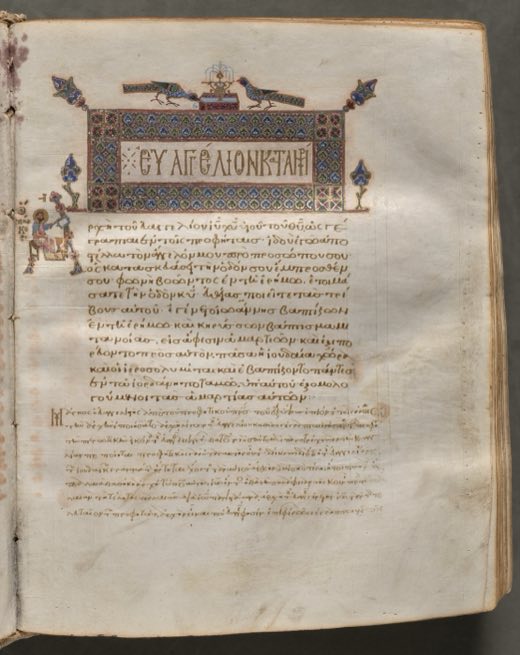
The Ottoman sultan Mehmed II took Constantinople after a siege of some seven weeks, ending the Byzantine Empire, the last part of the Roman Empire. Greek scholars, some carrying old manuscripts, moved to Italy.
Encyclopedia › Meanwhile in the world
In the Bible · c. AD 95 (by tradition) · Patmos, in the Aegean Sea
John on Patmos
On the small island of Patmos, off the coast of Asia Minor, John sees the visions written in the book of Revelation.
Gen 1:1–5
In the beginning God created the heavens and the earth. Now the earth was formless and void, and darkness was over the surface of the deep. And the Spirit of God was hovering over the surface of the waters. And God said, “Let there be light,” and there was light. And God saw that the light was good, and He separated the light from the darkness. God called the light “day,” and the darkness He called “night.” And there was evening, and there was morning—the first day.At the same time in the world
Printing from carved wooden blocks was centuries old in China, and Korea printed books with metal type before 1400. In Europe Gutenberg brought together a press, metal letters cast in a hand mold and an oil-based ink. His Bible was the first major book printed in Europe with movable type. Here is the world of the mid-15th century.
Greece and RomeConstantinople falls29 May AD 1453
ElsewhereA new alphabet for KoreaAD 1446
King Sejong of Joseon published a new alphabet for the Korean language, today called Hangul, so that ordinary people could learn to read and write. In its first form it had 28 letters; 24 are used today.
ChinaThe treasure fleetsAD 1405–1433
Admiral Zheng He led seven voyages of the Ming dynasty’s great “treasure fleet” across the Indian Ocean, as far as Arabia and East Africa. After 1433 the voyages stopped, and the court turned away from the sea.
The AmericasMachu Picchuc. AD 1450
High in the Andes of Peru, the Inca ruler Pachacuti had an estate built on a mountain ridge: Machu Picchu, with walls of finely fitted stone and terraces for crops. The Spanish never found it.
IndiaVijayanagaraAD 1336–1646
In southern India the Vijayanagara Empire ruled from a great city of temples, markets and water channels, today’s Hampi. A Persian envoy who came in 1443 wrote that he had never seen or heard of a place like it.
ElsewhereGreat Zimbabwec. AD 1100–1450
In southern Africa, the stone city of Great Zimbabwe, with curving walls up to 11 meters high built without mortar, traded gold and ivory with the coast of the Indian Ocean. By about 1450 it was being abandoned.