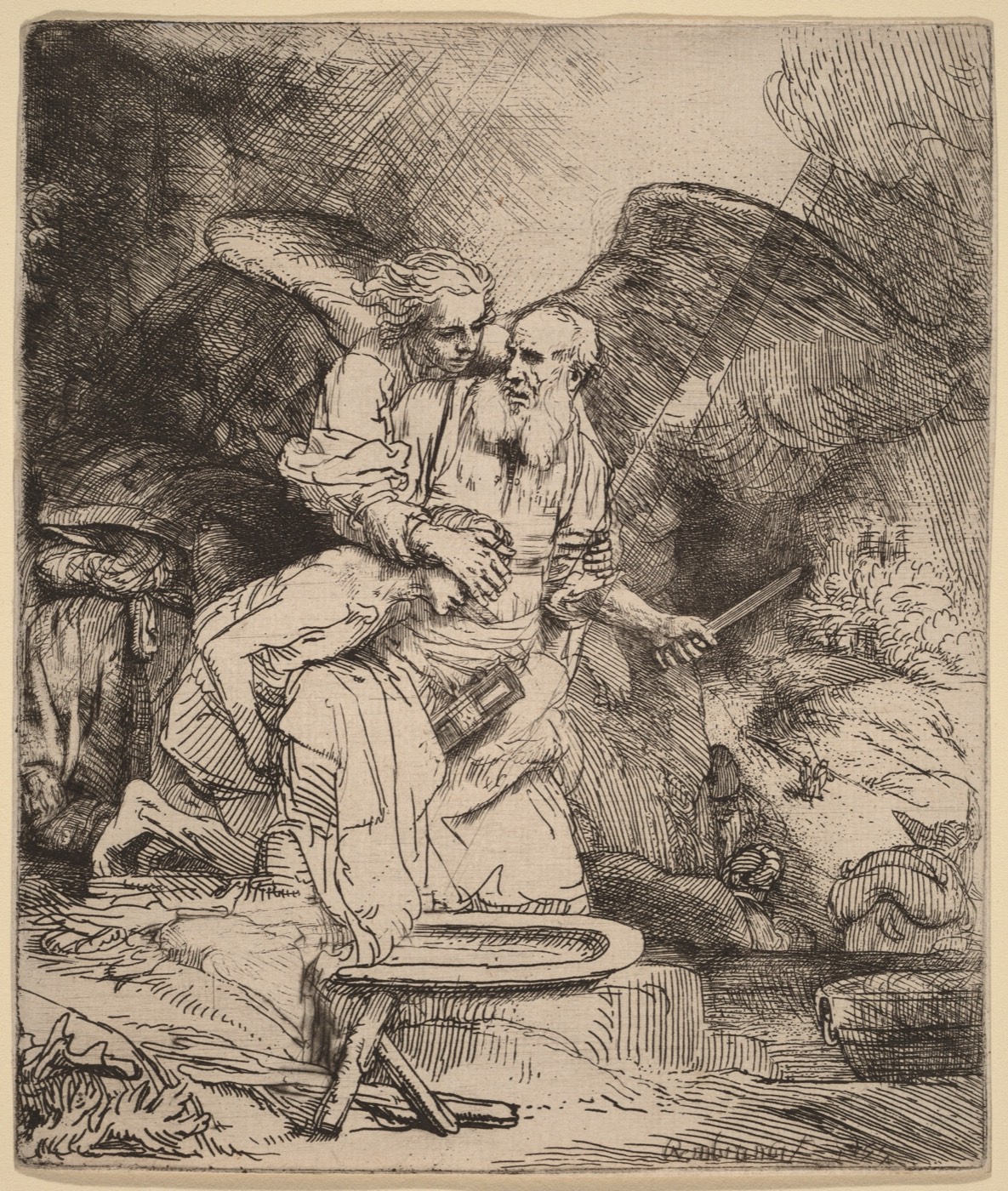
The angel close behind Abraham, both looking down.
Bible in art · Genesis
Abraham's Sacrifice
Rembrandt · 1655
National Gallery of Art, Washington
Rembrandt made this etching in 1655, twenty years after he had painted the same story. He drew with a needle through wax on a copper plate, let acid bite the lines, and scratched more lines straight into the copper; the print is only about 16 by 13 centimetres.
He chooses the last moment: the angel has come from behind, holding Abraham’s wrists, the knife still in his hand. Abraham’s other hand covers his son’s face. Down the slope at the right, the two servants wait with the donkey.
From the text
- Isaac bound on the altar on the wood (Genesis 22:9)
- The knife in Abraham’s hand (Genesis 22:10)
- The angel calling, “Abraham, Abraham!” (Genesis 22:11)
- The servants left with the donkey (Genesis 22:5)
The artist’s own
- The angel holding Abraham with both arms — in the text the angel calls from heaven
- Abraham’s hand over Isaac’s eyes
- Isaac kneeling against his father, not lying bound
Details
Two faces
A hand over the eyes
Abraham’s hand covers his son’s face.
The knife
Still in Abraham’s hand as the angel stops him.
Waiting below
The servants and the donkey, left at the foot of the mountain.
Rembrandt van Rijn, Dutch, 1606–1669. National Gallery of Art, Washington (Rosenwald Collection, 1943.3.7161) · Etching and drypoint · NGA Open Access: "Images of these works are available free of charge for any use, commercial or non-commercial, under Creative Commons Zero (CC0)." (NGA open data: published_images.csv openaccess = 1)